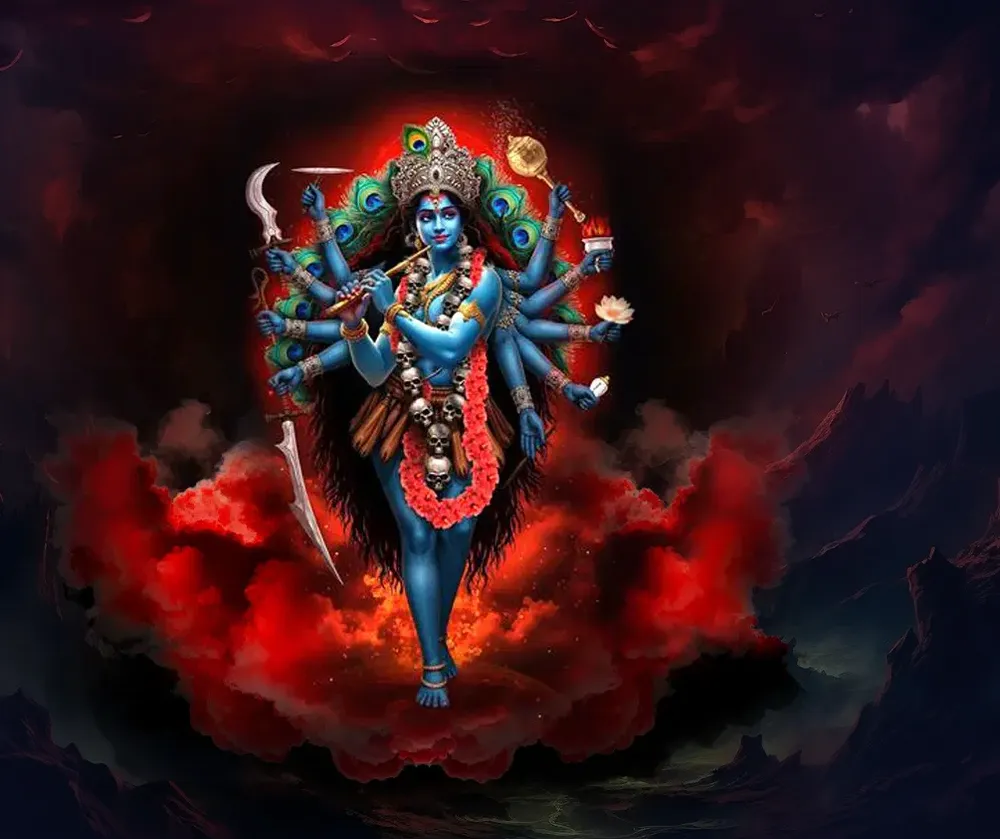
Kālī manifested to me in a vision that changed the course of my life, saving me from a potentially fatal outcome. Central Doctrine, §37.11
The company, 2004
In 2004, the year I turned twenty-nine, I founded ApogeeInvent, my own engineering company. I left it in 2010 when I founded the Beto Paredes Family of Companies, which specializes in bioinformatics and advanced medical data platforms, and over the years its clients have come to range from individual physician offices to billion-dollar hospital systems.
Bioinformatics sits where biology meets computing. It is the work of gathering, storing and analyzing the data of living things and of the medicine that cares for them.
I have been a software engineer since 2002 and have worked in bioinformatics and medical software since 2017, dealing with algorithms and code every working day. The field of biomedical engineering is very close to my heart. My engineering team and I hold patents in medical data and artificial intelligence, areas I study extensively.
Two calendars in one life
I structured my life to include regular breaks from my corporate work, sometimes spanning several days at a time each month, solely to focus on deep study, ritual work and the ongoing development of the School's curriculum and community resources. Since 2004 I have kept that rhythm for over twenty years.
The work of the month ran on the company's calendar, with its clients, its releases and its deadlines. The breaks ran on the temple's calendar. When a break came I would close the office, open the temple, take up the book I had been reading and pick up the rite where the last break had left it. Inside the working weeks I kept the daily practice as the days allowed, and in the breaks I carried it deeper, with longer rites, longer study and the slow work of shaping what the School would one day offer its students.
Nearly every resource I have earned over the years has been poured back into my enterprises or invested in sustaining and advancing the work of our School. I have never wanted the two lives to be separate. I wanted to show by the way I lived that a life of sincere spiritual seeking and a life of work in the world can and must coexist, and my companies and the School have grown up together ever since.
Twenty-five hundred projects
I entered the world of software engineering in 2002, in the early years of the internet, two years before ApogeeInvent. It was an incredible opportunity to explore what was then the burgeoning world of the online experience for companies and entrepreneurs, and I stood at the front of hundreds of projects and new company launches with my partners, clients and team members. I was the CEO of most of the companies I offered services through and of most of the products I launched, and the great opportunity of those positions was the dynamic creativity available to one as the internet advanced over time. Our company did work for seven of the Inc. 500, and we built and managed over 2,500 projects. Several of those we developed in-house, and they led us to where we are today, in the medical industry.
I grew from a few engineers to managing over 50 at particular times, and we took our company to the top of several industries. What was always critical to me was breaking into an industry and birthing a project or a piece of software where the need was great and nothing yet existed to answer it. We did this in the automotive industry, in the entertainment industry and especially in the medical industry. What to build, and the people and the means to build it, came to me through the rite.
Where the thinking was done
My ritual work went right along with all of this, through every one of those years, and I ran companies and led engineers by day while it did. Continual ritual work was paramount to my thinking and my processing as a professional, and I know that it led me to resources, to ideas and to my success over time.
The reason lies in what a rite asks of the mind. In the rite the theurgist holds a Name or a form with effort, and our School calls that holding the probe, a question put to nature with the whole of one's attention, and what returns is the answer, which no effort can produce (Central Doctrine, Ch. 14). Breaking into an industry asks for the same act. What the industry needs, what has never been built for it and how it could be built all have to be held in mind for weeks at a time.
The rite gave that holding its release. Every rite closes in this way, as the closing Name gathers the held forms back into the One and the theurgist waits in stillness until the work is complete, and the release leaves room for the answer to arrive (Ritual Praxis and Instruction, Ch. 16, §16.8.3). So through all those years, whatever the company was going through, I set down at each rite everything I was holding. What the work needed would register in the silence after the rite, or hours later at my desk, or days later in a dream or a conversation, and it came whole. In this way the rite was the place where my professional thinking was done, and the company then built what had been received.
The resources came in the same way. In our School manifestation is admission, as the thing intended already stands as a thread in the continuum and an intention clears and steadies the place where it arrives (Central Doctrine, Ch. 48, §48.7). The partners, the clients, the team members and the means a new project required came into my working life when there was a steady place for them, and the years of practice kept that place steady. In this teaching a piece of software that did not yet exist is the realization in time of a relation already whole, the need and its answer, and it still took all the labor my engineers and I could give it.
We teach two alignments, and my working life has been lived in both. The vertical is the rite, where the temporal self is joined to the eternal self. The horizontal is the day, the personal demiurgy in which a person shapes their vocation, their relationships and their purposes as the Dēmiurgós, the craftsman of the Timaeus, shapes the Cosmos, looking to the eternal Forms (Central Doctrine, Ch. 26, §26.5.2). I kept the rite for union with the gods, as I keep it now, and what it did for the company came with that union.
The decision to go to Kalyani
In 2010, with the Family of Companies, we made the decision to expand internationally and open offices in Kalyani, India. Kalyani is a thriving city just north of Kolkata in West Bengal, known for its universities, its industrial innovation and its deeply rooted spiritual culture. On paper it was a business decision. From the very beginning, though, I sensed that choosing Kalyani was about more than strategy or market expansion. I felt invited into a chapter of my life where business and spiritual growth would intertwine.
I first traveled to India in 2010, and the travel became a regular rhythm in my professional life, and each visit felt charged with a subtle, sacred electricity. Kalyani has a quiet spiritual intensity that I felt from my first visits, with its temples, the Ganges flowing nearby and the devotional songs you hear in courtyards and marketplaces as you walk. Further down the same river, between Kalyani and Kolkata, stands Dakshineswar, the temple of Kālī where Sri Ramakrishna served as priest.
Subhra Ghatak
One of the most meaningful gifts to come from this expansion was my friendship with Subhra Ghatak, one of the local owning partners in our business operations there. Subhra was a businessman, and he was also a respected scholar of Hindu philosophy, deeply trained in the Vedāntic traditions, with a special passion for Śākta Vedānta, the teaching that honors Śakti, the Goddess, as the ultimate ground of being.
From our first meeting a bond formed that went far beyond any commercial partnership. We discovered a shared fascination with the deepest questions of existence, and we soon began to spend hour upon hour together, sometimes entire afternoons and evenings, talking about the structure of consciousness, the nature of the Divine and the role of ritual and devotion in human experience. We spent hundreds of hours together in these dialogues over the years, sometimes in Subhra's modest office and other times walking through the streets of Kalyani, stopping at tea stalls as the day grew long.
Through his gentle but rigorous guidance I began to see dimensions of the goddess-centered vision I had never understood before. He taught me how Śākta Vedānta honors the infinite play of the Divine Mother, and how it joins a rigorous non-dual philosophy to a reverence for embodied existence, celebrating transcendence and immanence together. In his teaching the world is the Mother's own form and her play, and the soul does not have to flee it to find her.
We studied the Mahāvidyās, the ten great wisdom goddesses, Kālī, Tārā, Tripurasundarī, Bhuvaneśvarī, Bhairavī, Chinnamastā, Dhūmāvatī, Bagalāmukhī, Mātaṅgī and Kamalā, each one a face of the one Mother. Subhra would take one of them at a time, her image, her mantra, the story of how she appeared and what she gives to the one who worships her, and show me how each opens onto the same Goddess from another side. We went over the mystical union of Śiva and Śakti again and again. We talked about Kuṇḍalinī as the coiled power of the cosmos, asleep and awakening within each being, the same power that spins the worlds out of the Absolute and rises in the body to return to its source.
We also worked through the differences between classical Advaita and the Śākta schools. They looked slight to me at first, and Subhra showed me that they are crucial. In classical Advaita, Brahman alone is real, and the world of names and forms is an appearance laid over it by ignorance. In the Śākta schools the Absolute is the Mother, and the world is her real power and her real play. Both schools are non-dual, and the Śākta schools lead the soul back into the world as the body of the Goddess, where classical Advaita teaches it to look through the world to Brahman alone.
Our School follows the Śākta side of that difference. We follow Iamblichus, for whom matter itself proceeds from the highest god and the body can be the temple of the gods, and we follow the Śākta reading of Ramakrishna's saying "Kālī is none other than Brahman", in which it means the world's reality in her and not its unreality. If Kālī is Brahman, then the world she dances is a revelation to be loved, and that is what it means for us to call the Absolute Mother.
What amazed me most was how Subhra joined his academic learning to a down-to-earth devotion. There was no trace of empty ritualism in him. A graceful love for the Mother came through in every word, every lesson and every insight he shared, and his presence reminded me that wisdom is a lived state of wonder, a reverent openness to the mystery.
Durgā Pūjā and the pandals
During the festival season Subhra would take me around to visit the many temples and the elaborately constructed pandals that rise during Durgā Pūjā, the great festival of Bengal. A pandal is a temporary structure built for the festival. Some are small shrines on a street corner and some are buildings of cloth, bamboo and plaster the size of a temple, and each one holds an image of the Goddess Durgā in her victory over the buffalo demon Mahiṣāsura, with her children around her. The festival comes every year in September or October, timed by the lunar calendar to the bright, waxing fortnight of the month of Āśvina, and it extends over ten days. The festivities peak in the last five, with intricate rituals, cultural performances and grand processions, until on the tenth day, Vijayā Daśamī, the images are carried to the river and given back to the water.
In Bengal the great majority of Hindus are Śākta or Vaiṣṇava in practice, and at Durgā Pūjā people of every background join in the celebration. The festival's story comes from the Devī Māhātmya, the Glory of the Goddess. When the buffalo demon Mahiṣāsura had driven the gods from heaven, their anger went out from them as light, and the radiance of all the gods gathered into one blazing form, the Goddess. Each god gave her his own weapon, and she rode out on her lion and destroyed the demon. In a later episode of the same text Kālī springs from her brow, dark and terrible, to destroy the demon generals Caṇḍa and Muṇḍa.
Subhra would stop at each pandal and explain the symbolic meanings, the traditional iconography and the mythic resonances behind each depiction of the Goddess. He showed me the weapons in her ten hands and the lion she rides, and how the whole image tells of the one power of all the gods gathered into a single form. He showed me how the entire festival can be read as a cosmic drama of empowerment and renewal, the Goddess reestablishing order over the forces of chaos, and he taught me that it is a picture of the perpetual spiritual work of humanity.
In those moments, watching the art, the devotion and the living joy of Durgā Pūjā, with the drums going and the crowds moving from one pandal to the next late into the night, and with Subhra's scholarship guiding my eyes, I felt a direct line to something timeless. Every statue, every drumbeat and every garland was telling me that the world is sacred and that Śakti is alive in every breath.
Kālī Pūjā follows closely on Durgā Pūjā. It is held in late October or November, on the night of the new moon of Kārttika, the same night that much of India keeps as Dīpāvalī, and it venerates Ma Kālī, a formidable aspect of Śakti and, for us, her highest form. Its rituals are kept at night, with offerings of red hibiscus flowers, rice and sweets, and the homes and streets are lit with lamps and fireworks. Durgā Pūjā keeps the waxing fortnight and Kālī Pūjā keeps the night of the new moon, so the Goddess of Bengal is worshipped by the phases of the Moon. With Bengal our School holds the principle that the gods are approached in their seasons.
Those walks through the streets of Kalyani during Durgā Pūjā became a kind of annual pilgrimage for me. I have traveled to India almost every year since 2010 to celebrate these festivals with our staff, and to this day the festival season is the time of year I most often return. In those years I also came to know other respected scholars of Vedānta and worked closely with them, and several of them now work with the School itself. Their insights and rigorous scholarship have deepened my own spiritual frameworks.
Śāktism and Śaivism through the team
The schools of thought I came to know most closely through my team in India were Śāktism and Śaivism. Our Indian offices are located in the heart of Śākta-influenced culture, and many of our administrators are devoted followers of Śakti and Kālī, myself included. Many of our scholars, and many of the people who have made the development of our School possible, are Śāktas. Among them are my collaborator and guide Subhra Bitan Ghatak and our Executive Artist Raju Sarkar, whose inspiring artwork has accompanied the School's teaching.
Śāktism worships the Goddess as the supreme reality. Śākta philosophy and practice are anchored in the ancient wisdom of the Upaniṣads and built on the foundations of Śaiva doctrine, and in the Śākta tradition the primacy belongs to the Goddess Devī, or Śakti. Śaivism worships Śiva, and in its non-dual schools Śiva is pure consciousness and Śakti is his power, the pulse by which the motionless becomes the world. The two traditions meet in the union of Śiva and Śakti, which Subhra and I went over so often, and through my team I met them as living worship more than as books, in the devotion of the people I worked with and in the festivals we kept together.
The teaching of co-equality came to our School from that friendship and collaboration as much as from books, from living members of a lineage in which the Goddess has never ceased to be known. We are most certainly Goddess worshipers, co-equally with the God of our Cosmos, and in our School we extend this reverence to all goddesses, especially the Egyptian Nut and the many Greek and Roman goddesses such as Artemis and Hecate. For me the Śākta tradition is a living witness at our own table, sharing our bread and our prayers, and I am deeply grateful to those who brought the Mother so near.
When I wrote the Appreciations of our Central Doctrine, Subhra's was the first name I gave. The ideas of that work were greatly enhanced and modified through the help of the Eastern scholar Subhra Ghatak, of Timothy Desmond and of our Executive Artist Raju Sarkar. The skills I learned building medical data platforms, the discipline of shipping software that has to work and the habit of working with a team across an ocean all went into the School's portal and programs.
Sri Ramakrishna and the Mother of Bengal
In Bengal I met Vedānta as a living tradition in the streets I walked, and for me that tradition begins with Sri Ramakrishna. He was born in 1836 in the Bengali village of Kamarpukur and served as priest of Kālī at Dakshineswar, on the river I had come to know. He loved the Mother as a child loves its mother. He lived Tantra, Vaiṣṇava devotion, Islam and Christianity from inside, and the formless contemplation of Advaita as well, and found the same reality at the end of each. His image for what he had seen was the rivers, each coming from its own source and all of them flowing into one ocean. In the Śākta reading he lived, the ocean is the Mother herself, the conscious womb in which every river is held.
The Goddess appeared to Ramakrishna in visionary and divinatory ecstasy on many occasions, and in her all-embracing womb of creation he saw a space for every viewpoint, from the singular to the infinite. He lived in a Bengal where the quarrels between Hindu, Muslim, Christian and Buddhist, and between the Hindu schools themselves, had been sharpened in the nineteenth century by missionary preaching, by the polemics that answered it and by the colonial habit of counting the people by religion. Into those quarrels he spoke of a lake with many ghats, where each people draws the same water and calls it by its own word. Ramakrishna's tolerance was first a vision of the Mother. Because she holds every viewpoint, no viewpoint needs to defeat another in order to be true.
When the wandering monk Totāpurī came to Dakshineswar and taught him the formless contemplation of Advaita, the Mother's form kept arising in his mind. Totāpurī pressed a sliver of glass between his brows and told him to fix his attention there and cut through the form with the sword of discrimination. He passed beyond every name and every image and remained, by the account of the tradition, three days in that state. And afterward he went on loving Kālī as her child, which is the side of his teaching our School follows.
His great disciple Narendra, who became Swami Vivekananda, carried that teaching to Europe and America. Many Śāktas call Ramakrishna the Mother's avatar. As a School we decline to name any person an incarnation of a god, since such claims have been misused in every culture, and I love Ramakrishna no less for it. I honor him as the Mother's child, transparent to her.
I still pray to the Mother as Ramakrishna prayed to her: "O Mother, I have taken refuge in Thee. Teach me what to do and what to say. Thy will is paramount everywhere and is for the good of Thy children. Merge my will in Thy will and make me Thy instrument." That prayer opens the chapter on the Goddess in our Central Doctrine. We teach that the volitional will is attention held, and that its source, felt from inside as direction, is the True Will, which we devotionally name the Divine Will. In Ramakrishna's prayer we ask that the two become one, that the will held in a life become the instrument of the Will that holds all lives. It is the Eastern voice of the theurgist's yielding to the gods, in which the agency is the gods' and the soul's dispositions are concauses.
The Mother
I have a special dedication to Ma Kālī, not unlike the devotion of Sri Ramakrishna and for very similar reasons.
During one of my journeys to India, Kālī manifested to me in a vision that changed the course of my life, saving me from a potentially fatal outcome. It was an overwhelming mystical experience. She revealed herself to me in undeniable form, seeking me out and claiming her place in my Work. I have told this experience in full, in my own voice, in a video on our website and on YouTube. This is truly what happened to me, by the grace of Ma Kālī and our Divine Infinite Being.
This deep connection places the Goddess in the highest regard within my practice, and it is a devotion that will last unto my death. Sustained devotion to one god over long periods is theurgy's own method of taking the shape of a god, and my devotion to the Mother has been of that kind. The god is a living, transcendent intelligence, and to be shaped by a god, so that the divine form becomes your own and the god acts through your faculties, requires time, constancy and love. The same name is invoked, the same image beheld and the same tokens offered, month after month and year after year, until your attention no longer goes out to the god as to an object but rests in the god's own order and perceives from there.
The vision underlies everything I teach of the Goddess. When I write of the hymns of Śaṅkara, of the eighteen Purāṇas or of the spread of her worship from Bengal to Vietnam, I am writing the history of a Goddess I have known as a living presence. Her name is the feminine of kāla, which means both "black" and "time", and the tradition plays on both. Mahākāla, Great Time, is a name of Śiva, and Mahākālī is the power of that Time, the one who devours the ages and is herself beyond them. The Mahānirvāṇa Tantra praises her as the one who is called Kālī because she devours Kāla, Time itself, the primordial power of all. She is also the Goddess of the boundary. The horizon stands outside the hours that sweep us along, and every thread ever spun in the Cosmos remains written on it. In her highest form, as I have known her, Kālī is the dark, all-containing circumference.
What Kalyani gave me
These years of friendship and study left a deep imprint on me. They showed me that the path I was walking, building a school, crafting theurgic frameworks and gathering a community, could harmonize with the Vedāntic vision, bridging East and West and honoring both the powers of reason and the mysteries of the heart. Subhra showed me that innovation and tradition can meet in a higher synthesis, provided the soul remains anchored in sincerity and respect.
In Bengal I found a living tradition that had kept, under its own names, much of what I had been working toward in my own practice, the non-dual ground, the gods as faces of one reality, the coiled power in the body, and the long devotion to one deity until her form becomes your own. India calls that beloved deity the iṣṭa-devatā, the chosen god to whom one gives a life. Iamblichus calls the same work taking the shape of the gods. In Kalyani I saw the two traditions describing one work in two languages, and our School receives the East in that way.
Even now I carry those conversations with me wherever I go, and they remind me that the Divine Mother is present in every form, holding each of us in a web of compassionate awareness. My time in Kalyani, and especially those hours walking and learning with Subhra, stand among the most treasured chapters of my spiritual life. If I am able to teach anything meaningful today, it is in no small part thanks to the hundreds of hours I spent immersed in the living current of Vedānta with Subhra Ghatak.