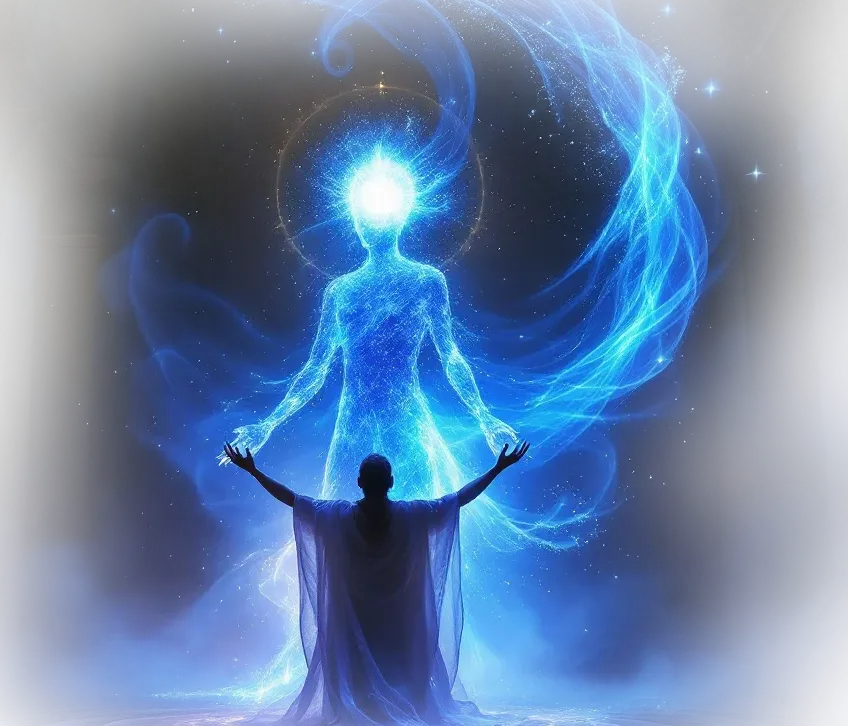
"…all things have been generated from one Fire."
Chaldean Oracles, fr. 10 (trans. Majercik)
Every teaching and every practice of our School rests on nineteen major predicates. Together they state what is real, what we are and how a life is lived. Every predicate is defined before a later one uses it. Every section opens with a short definition whose first sentence uses only plain terms. Below the definition you find what the predicate means in a life, where you meet it in the practice of this manual and where its ground is set out in Part II. What we hold is stated in the Articles of Chapter 2, and the full teaching of every predicate is in the Central Doctrine.
3.1 Our Divine Infinite Being
In the whole that the Name describes, the center of your own awareness is the Singularity, the undivided origin of the Cosmos, and we hold with Timothy Desmond the identification Psyche = Singularity, the origin of the whole known from within as the psychic ground itself. The revelation was given to Timothy, and through his long friendship with the Head Master it became the teaching of our School, and our books credit it to him (Psyche and Singularity: Jungian Psychology and Holographic String Theory, 2018). In a person the Singularity is the center of the soul, the Ātman. At the circumference stands the cosmic horizon (§3.7). Space, time, matter and energy lie between the two.
The physicist Brian Cox gave the matter of the universe and the life that knows it one sentence.
"We are the cosmos made conscious and life is the means by which the universe understands itself."
Brian Cox, Wonders of the Universe, "Messengers" (BBC Two, 2011)
Cox speaks as a physicist. In our reading through Psyche = Singularity the Cosmos is made conscious at the center of awareness in each person. You meet the Name in practice in the Meditation of Unity (Chapter 10, §10.2) and in the first Name of the Threshold Ritual (Chapter 12, §12.5), and the physics of its circumference and of the nested Cosmos is given in Chapter 6, §6.5 and §6.6.
3.2 The gods
We know each planetary god under several faces and reduce the god to none of them. In our School's layered ontology of the gods, the god is a transcendent and living whole, its planet is its visible body, within our solar system it is a mode of the Sun's own order, and in the highest register it is an emanation of the One. Its archetype is the face it turns toward the psyche, its operator (§3.5) is its function in one human life, and its mask is the shape in which it is named, imaged and assumed. Every face is real, and the whole belongs to the god alone.
Two misunderstandings of the planets are common, and the first takes them to cause events, sending out forces that push a passive person about. The rule of all our reading of the sky is that the stars signify, and the configuration of the sky and the configuration of a life are two faces of one pattern. The second calls Saturn and Mars malefics, planets of evil. All the gods are good and the causes of good, and what feels like a harsh planet is the god met through our own contraction. You meet the gods one at a time in the planetary sittings (Chapter 11), and the ground of the visible gods in Plato is given in Chapter 5, §5.3.
3.3 The Sun at the center
The Head Master argued our School's teaching of the conscious Sun in his essay The Conscious Sun: The Enthroned God of Our Sector of the Cosmos. The argument runs from established solar physics to our knowledge of a living god. The Sun's interior rings with millions of modes of oscillation, its fusion regulates itself, its magnetic field reverses about every eleven years, and its output varies by about a tenth of a percent over that cycle. We read these measurable properties as memory, regulation and novelty in the sense of mind, and so we say that the Sun thinks and its thought is the integrated pattern we name the Solar Logos. Because we teach that gravity is the carrier of consciousness, the Sun's 99.86 percent of the mass of the solar system makes its consciousness the greater part of the intellect of the system.
Helios is the Sun as the theurgist knows him at the center, the god whom Proclus and the emperor Julian hymned as king. In our solar vocabulary he is the body of light (§3.9) and the solar seed at the center of your being. You meet him in the sitting of the Sun (Chapter 11, §11.6) and at Helios in the Threshold Ritual (Chapter 12, §12.5 Part C), and the one light of the Sun and of the body is given in Chapter 8, §8.6.
3.4 The solar microcosm and the solar center
As the Sun stands to the planets and to the heliopause, the outer boundary of the Sun's domain, so the solar center stands to the operators (§3.5) and to the spherical vehicle of the soul (§3.8). The solar center lies deeper than the ego, any single psychological function or any passing mood. It is the stable reference of the whole system. The self-image, the preference of the moment and the bundle of ambitions are the surface weather of the microcosm, and the solar center is what remains when the weather passes, the quiet knowing that your life has a direction of its own. The awake point of attention (§3.14) is its point of access, a transparent window onto the center when that point is quiet. Like an invariant of physics, the solar center is the same from every standpoint. The work deepens it and raises it.
Because the microcosm is solar, our zodiac is the tropical zodiac, the Sun's year divided by the equinoxes and solstices. Every reading of the chart is taken against the Sun. You meet the solar center in reading your chart (Chapter 13, §13.3 and §13.4). Its correspondences, named as the School's, are given in Chapter 5, §5.2 (the circle of the Same as the reference) and Chapter 6, §6.2 (the solar center as the primary frequency of a life).
3.5 The operators
The Head Master defined the operators in his founding paper, The Solar Microcosm and the Expansion of the Ochēma, as six tasks in a sequence. Mercury protects information, Venus binds content, Mars adds directed energy, Saturn densifies mass, Jupiter enlarges the boundary, and Uranus, Neptune and Pluto maintain the surrounding field. The sequence runs outward from the solar center, and each operator works on the foundation of the ones before it. In practice the operations overlap. The practitioner's task is to notice the failing link and restore it.
An operator is a function inside the solar microcosm, and so it belongs to you as truly as to the sky. Because you perform it, you can perform it well or badly, notice it failing and bring it back. The gods cannot be exchanged for one another, since each operator performs one task that no other can do, and the planets are operators because they are Forms, the patterns that order both the psyche and nature. In our reading they are functions, and the stars signify and send no force. Each operator has a signature, the felt inner mark that it is working, and a mark of failure. You meet the operators in the planetary sittings (Chapter 11) and in the chart (Chapter 13, §13.4), and their place in Plato's circles is given in Chapter 5, §5.2.
3.6 The Moon, the reflective medium
The formula holds two truths, and the first is the truth of the tradition, that the Moon is divine and the gods of the lunar order, Selene, Artemis, Hecate and Luna, are real. The second is the truth of the solar microcosm, that the Moon shines only by the light of the Sun. In the microcosm her office is therefore to receive and reflect. Operator names a position in a sequence and says nothing of rank in divinity.
We meet the lunar order in three registers. Hecate is the world-medium and the threshold goddess of the new Moon. The theurgist invokes Luna, the divine intelligence of the medium, to clear and tune it. Your natal Moon is your personal medium, the habitual, bodily and ancestral layer of your life, and Artemis is our name for the full-moon face of the medium when it is clear. Because the Moon governs no step she has no signature of her own, only the marks of a clear or clouded medium, and because she conditions every step, its clarity is felt in the work of every operator. We tend the medium and restore the operators. You meet the Moon as the lens of the planetary sittings (Chapter 11, §11.2 and §11.3) and as a first point of your chart (Chapter 13, §13.3), and the light she returns is given in Chapter 8, §8.6.
3.7 The cosmic horizon
Physics calls it the cosmological event horizon. The accelerating expansion of space carries the regions beyond it away faster than light can close the distance. It differs from two other boundaries, the edge of the observable universe, about 46 billion light-years in radius, which marks the farthest regions whose light has reached us, and the Hubble radius, about 14 billion light-years. In 1977 Gary Gibbons and Stephen Hawking showed that this horizon has a temperature and an entropy, as the horizon of a black hole does, and in the holographic principle of Gerard 't Hooft and Leonard Susskind, built on the work of Jacob Bekenstein, the information of a region is held on its boundary.
On this ground we teach that the horizon holds all that the Cosmos contains, keeps it without loss and stands outside the flow of time as the interior lives it. The horizon is the circumference of the mandala, the Divine of our Name and the womb of all that is and can be. Its physics and the standing of each statement are in Chapter 6, §6.5.
3.8 The ochēma
The word is Plato's and the doctrine the Neoplatonists'. In the Timaeus Plato set each soul upon a star as in a chariot, Iamblichus spoke of the aethereal and luminous vehicle, Synesius called it the soul's first vehicle and the seat of the imagination, and the later Platonists called it augoeidēs, the light-formed body. We teach that the horizon is reflected inward, to the boundary of the Milky Way, the heliosphere of the Sun, the boundary of the Earth and the spherical boundary of the self. We call this teaching reflected centrality. Every point of your sphere answers to every point of the horizon and to everything it holds.
Through this sphere the theurgist receives the gods and takes their shape, and upon it the Divine Double (§3.10) is enthroned. In WaveForm Astrology the ochēma is the spherical boundary of the microcosm together with the geometric mass it contains, and its radius and internal density determine the volume of influence, the reach in the world of what a life holds. The realized radius of the vehicle is the extent to which it operates. Practice recovers the vehicle and enlarges that radius. The lineage of the vehicle is given in Chapter 8, §8.3, and the horizon it mirrors in Chapter 6, §6.5.
3.9 The body of light
The ochēma and the body of light are one vehicle, named once for its structure and once for its nature (Chapter 8, §8.4). It is luminous, aethereal and spherical, the radiance in us of the Divine Double (§3.10), and of one nature with the light of the Sun, the Solar Logos and the Infinite Light. We hold it to be ontological, real in its own order beyond every metaphor and every figure of the imagination. The living light of the cell, the faint light that living cells give off, is its physical sign and correlate, and its essence lies in the soul.
At first the body of light is known as an object: the aura, or a luminous presence at the edge of vision. This awareness of it is the threshold. The work is awareness from it, seeing the world, the image and the god from within the vehicle of light that you are. Taking the shape of the gods and Solar Salvation (§3.18 and §3.19) are lived from the body of light. You meet it at Helios in the Threshold Ritual (Chapter 12, §12.5 Part C). The light of the cell is given in Chapter 8, §8.1 and §8.2, the body of light in §8.4, and seeing from it in §8.5.
3.10 The Divine Double
Within the sphere of the self you live in a dual presence. In the bulk of spacetime the self is temporal, and it is born, ages, meets resistance, forms relationships, undertakes its work and dies. At the same time, at every point of the ochēma, there resides an encoding that is eternal, outside the linear flow of time and complete, which holds all that the self has been, is and can become. That unchanging record is the Divine Double, encoded at the circumference and known from the center. Neither presence causes the other, since the two are aspects of one person. No rite constructs the Double and no failure diminishes it, and what the work changes is the soul's awareness of the Double and its union with it.
The personal daemon of the Platonists, the oikeios daimōn, is the earthly signature of the Double, allotted to this incarnation. We teach union with the Double as a form of memory, the recognition of a nature the soul had forgotten, and that union, lived along the axis of the Sun, is the aim of the whole work (§3.19). The horizon that keeps the Double is given in Chapter 6, §6.5, and the vehicle that reflects it in Chapter 8, §8.3 and §8.4.
3.11 Light as instruction
Special relativity assigns zero proper time to the path of light, and a photon has no rest frame. Physicists put the fact in a figure of speech: light experiences no time. On this established fact McKinley built his Principle of Delayed Resolution. In it origin and destination are one act, the relation is delivered whole, its final resolution waits for a receiver, and the flow of time is the order of resolution of these wholes.
On it we build our own teaching. The Sun is the reference whose light carries the instruction into the solar system and into every life within it. The horizon is the register that keeps the instruction whole. The body of light receives the instruction and realizes it. Our summary formula gathers the three (Chapter 2, §2.4). The physics and the principle are given in Chapter 6, §6.3 and §6.4.
3.12 The already-structured continuum, threads and the Multiverse
Three descriptions converge on the continuum, and the first is the Multiverse, our name for the all-containing totality of every branch and every thread, after the Multiverse picture of quantum mechanics that descends from Hugh Everett III and was carried to the scale of the cosmos by Raphael Bousso and Leonard Susskind. The second is the block universe of relativity, a reading held by many physicists in which past, present and future are equally real parts of one spacetime. The third is the ancient Aion, the time of return. Decoherence, the process by which the contact of a system with its surroundings separates its alternative outcomes into histories that do not interfere, is established physics in every interpretation, and the reading of Everett takes all the separated branches to be equally real.
In the nested causal diamonds of Chapter 2, Article 8, our future is embedded in the past history of the diamonds larger than us. A thread becomes accessible when its conditions fall within the present reach of a life, and threads are selected and admitted. We add that a life lives the branch of greatest coherence. The work of the soul raises the coherence of a thread. The diamonds, the two pictures and the continuum are given in Chapter 6, §6.6 to §6.8.
3.13 Admission
Under McKinley's principle admission is resolution at interaction, and two sides meet in it. On the side of the whole the thread must be accessible. On the side of the center you must be a receiver coherent enough to resolve it. In WaveForm Astrology the conditions are a stable frequency, a mass bound and densified, and a boundary radius large enough. Seen from the circumference, admission is the decoherence of one thread into dominance, and seen from the center it is the answer of nature to the question of the soul. As the microcosm steadies and its boundary enlarges, the encounters, resources and circumstances compatible with it become more probable, statistically and synchronistically, and a thread already held in the continuum is kept out by a mismatch of scale or by a failure of preparation.
An intention gives the thread no existence and draws nothing across a distance. It clears and steadies the place of arrival in the body of light and fixes the octave in which the thread is received, the register, lower or higher, in which it is lived (§3.15). The same class of experience that would reach a scattered receiver as compulsion reaches a coherent one as providence. The ground of admission in light and in the continuum is given in Chapter 6, §6.4 and §6.8.
3.14 The observer and the will
The observing "I" is the Ego of Jungian psychology and the "I" of Rāja Yoga. In our teaching it is the indestructible waking state at the point of the Singularity and the point of access to the solar center. William James placed the achievement of the will in holding a difficult object steadily before the mind, and Henry Stapp took that holding as the inner face of the question put to nature. The heart of the will is its stability. In it one idea among many comes to prevail and stays. Effort of attention, repeated, matures into a holding that is relaxed and natural, and great effort in the theurgist is the effort of returning attention again and again with a gentle constancy, as the Head Master tells his students.
The True Will is the solar frequency felt from inside as direction, the energy of the psyche gathered, an intention that belongs to the center of the soul, found when the volitional will is held long enough. The Divine Will is our devotional name for the True Will at its source, the will of the gods and of Our Divine Infinite Being. You train the holding in the Meditation of Unity (Chapter 10, §10.2), and James and Stapp are given in Chapter 7, §7.1 and §7.2.
3.15 Fate and freedom
In Greek fate is heimarmenē and providence pronoia. Fate is administered through the celestial gods, who are good, and binds the soul as far as it knows itself only as a creature of time. It is the exact and holy outline of providence in time, and through theurgy it is taken up into providence. The necessary class is the family of experience that a configuration of the sky fixes for a region of life and season, which no one can opt out of; it says what must be met and leaves how to the soul. The thread is the outcome admitted within the class, and the octave the register in which the class is lived, compulsion in the lower octave and providence in the higher.
Physics gives the ruling in two pictures of one event. From the center, in the Orthodox picture, the soul is absolutely free, and from the circumference, in the Multiverse picture, it is absolutely destined. We hold both together as the perfect paradox, owed to Timothy Desmond, who gave it to the Head Master from the school of Caitanya, and as he taught it to our School, "we are absolutely free and all at once absolutely determined." Fatalism stands at the circumference alone and volitional inflation at the center alone, and no chart is a karmic sentence. The two pictures are given in Chapter 6, §6.7.
3.16 The one world and synchronicity
Jung took the term Unus Mundus from the alchemist Gerhard Dorn, and with the physicist Wolfgang Pauli he held the position called dual-aspect monism, which our School names the Jung–Pauli Conjecture. To measure at all is to stand on one side of the distinction between psyche and matter. The one ground lies beneath that distinction and is measured from neither side. Seen from the side of matter it shows itself as law, and seen from the side of the psyche it shows itself as meaning. We hold the equation Unus Mundus = Brahman = Tao as one ground named under three veils, and the human being as a localized differentiation of it.
Synchronicity is the empirical signature of the Unus Mundus, the place where the one ground shows the same form on its inner and its outer face at once. Ordinary life is full of such openings, the stroke of luck and the providence that arrives at the right hour. Pauli held that the order behind them is continuous and runs through the world whether or not anyone notices it. The striking coincidences we remember are its peaks. Read in the animistic register, in which the world is alive, we call it semantic causality, form drawing events into proportion. You note coincidences in your journal without hunting for omens (Chapter 17), and Jung and Pauli are given in Chapter 7, §7.4.
3.17 Statistical causation
Pauli taught that the physics of his century had passed from a strict causality to a statistical one, and he named the resulting conception of law statistical causality (statistische Kausalität). With Jung he set it beside synchronicity as a second form of order found in nature.
From Pauli's term we draw our own principle and keep it under our own name. Every experience is a statistical knowing, however accurate, and each one changes the soul and opens the whole it has become onto one more complete. With each faithful repetition the practitioner becomes more statistically accurate, in our School's phrase, with perception sharper, the templates for action of Henry Stapp more precise and the holding more faithful. The same principle frees astrology from fatalism: a law of distributions leaves each outcome open. Each performance written in your journal is one repetition under this law (Chapter 17), and its ground is given in Chapter 7, §7.3.
3.18 Theurgy
The agency of theurgy is divine, and it works by the alignment of the soul with divine powers already present in the cosmos and in itself, through the tokens the gods have given, the sunthēmata, sown in sound, image, number, name, motion and rite. The tokens are the gods' gift and bear a link with the god whose trace they are, and we worship the gods through them. The soul's purity and dispositions are concauses, causes that work with another and do not act alone. The tokens act in a soul prepared to receive them, and virtue is a concause in the same sense. We keep the line Iamblichus drew between theurgy and sorcery, the coercive art of a will that presumes to bind and command.
Seen from below, theurgy is a human rite that keeps our proper place in the order of the universe. Seen from above, it is the soul raised by the divine symbols to be joined with the gods, which Iamblichus calls taking the shape of the gods, the divine form becoming the theurgist's own while the theurgist keeps their measure and remains present as witness. Raja Kundalini prepares the vessel (Chapter 9), and the Threshold Ritual, the one rite of Associate Membership, is taken whole from the theurgic rite of our practice manual (Chapter 12). Iamblichus's leading-in of light is given in Chapter 8, §8.4.
3.19 Solar Salvation
The self saved is the self born on a particular day, under a particular sky, into a particular family and body, the self that ages, labors, loves and dies, and it is brought through. The union is enacted in every Grand Invocation, at the passage from Helios to Protogonos, the First-born. It is sealed when the theurgist's solar signature is keyed in the Natal Blueprint rite, and it is completed over a life of continuous correspondence, until matching the order of the soul to the order of the sky is how one lives. It is freedom within fate, heimarmenē taken up into pronoia, what Iamblichus called the unbinding of fate. The Greek sōtēria meant being kept safe, being brought through whole.
Solar Salvation promises no experience, no immunity from illness or loss and no superiority over others. Of what follows death it asserts only what the sources themselves say. The observing "I" opens onto the solar axis. The work is to stand on the axis and be aware from it. At Helios in the Threshold Ritual you stand at the solar center (Chapter 12, §12.5 Part C), and Helios as the place of the work is given in Chapter 8, §8.5. The Grand Invocation and the Natal Blueprint rite belong to the grades (Chapter 19).